
he 2008 Wimbledon final didn't just produce a champion;it gave tennis a new measuring stick. Rafael Nadal, the relentless lefty from Mallorca, ended Roger Federer's five-year reign on grass in near-darkness。9-7 in the fifth. That match, often called the greatest ever played, crystallized what the Nadal and Federer rivalry meant: two utterly opposite approaches to the sport, each pushing the other to heights neither might have reached alone. Federer's fluid grace and Nadal's brutal topspin became the twin poles of a golden era.
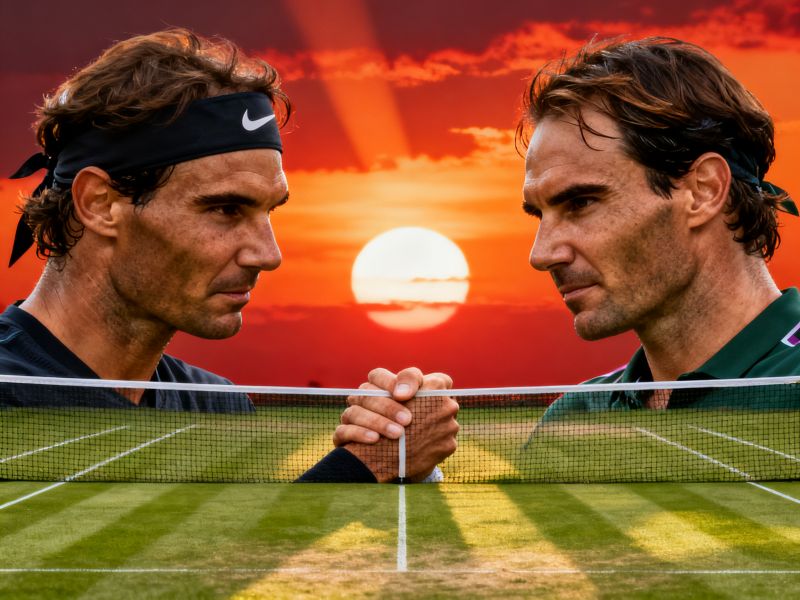
Their head-to-head record tells a lopsided story on clay—Nadal won 14 of 16 French Open meetings—but Federer's five-set triumph in the 2017 Australian Open final, after a five-year Grand Slam drought。flipped the narrative. I watched that match in a packed bar in Melbourne;strangers hugged. Federer's backhand, once a liability against Nadal's high bounce, had become a weapon. Nadal, visibly fatigued, still chased every ball. The symmetry was almost poetic: Federer denied Nadal a 15th major that night, but Nadal had already denied Federer a calendar Grand Slam in 2006 and 2007. Their careers were a series of mutual obstructions that somehow produced more, not less, greatness.What separated Nadal and Federer from other great rivalries—Borg-McEnroe, Sampras-Agassi—was the sheer volume of high-stakes matches. They met 40 times on the ATP tour, nine in Grand Slam finals. Federer won 20 majors;Nadal, 22. For nearly two decades。every draw felt incomplete without them on opposite halves. Their styles clashed in ways that exposed weaknesses: Nadal's forehand attacked Federer's one-handed backhand with surgical repetition;Federer's serve-and-volley aggression tested Nadal's deep return position. Tactical adjustments became a chess match played over years. Federer switched to a larger racket head in 2014;
Nadal shortened his service motion in 2016. Each change was a direct response to the other.Off the court, the contrast was just as sharp. Federer, the Swiss precision of press conferences and polite distance;Nadal, the sweat-soaked intensity and superstitious water-bottle alignment. Yet they co-founded the Laver Cup in 2017, turning their rivalry into a partnership. When Federer retired at the 2022 Laver Cup, Nadal wept beside him. That image—two men who had spent their prime trying to destroy each other's legacy。
now holding hands—felt like the closing chapter of a shared biography. Federer's last match was a doubles loss with Nadal. You couldn't script a more fitting end.Their influence extends beyond trophies. Junior tennis enrollment spiked in both Spain and Switzerland during their peak years. Coaches now teach the Nadal forehand and the Federer slice as standard repertoire. The Big Three era。with Djokovic as the third pillar, might not have existed without the Nadal-Federer arms race setting the bar. Djokovic himself has said their rivalry forced him to become a complete player. So when you watch a young player today ripping a heavy topspin forehand or gliding into a backhand slice, you're seeing the fingerprints of Nadal and Federer—two rivals who, by refusing to yield, gave tennis its modern blueprint.